Stainless Steel vs Galvanized Steel: Differences, Pros, Cons & Use Cases
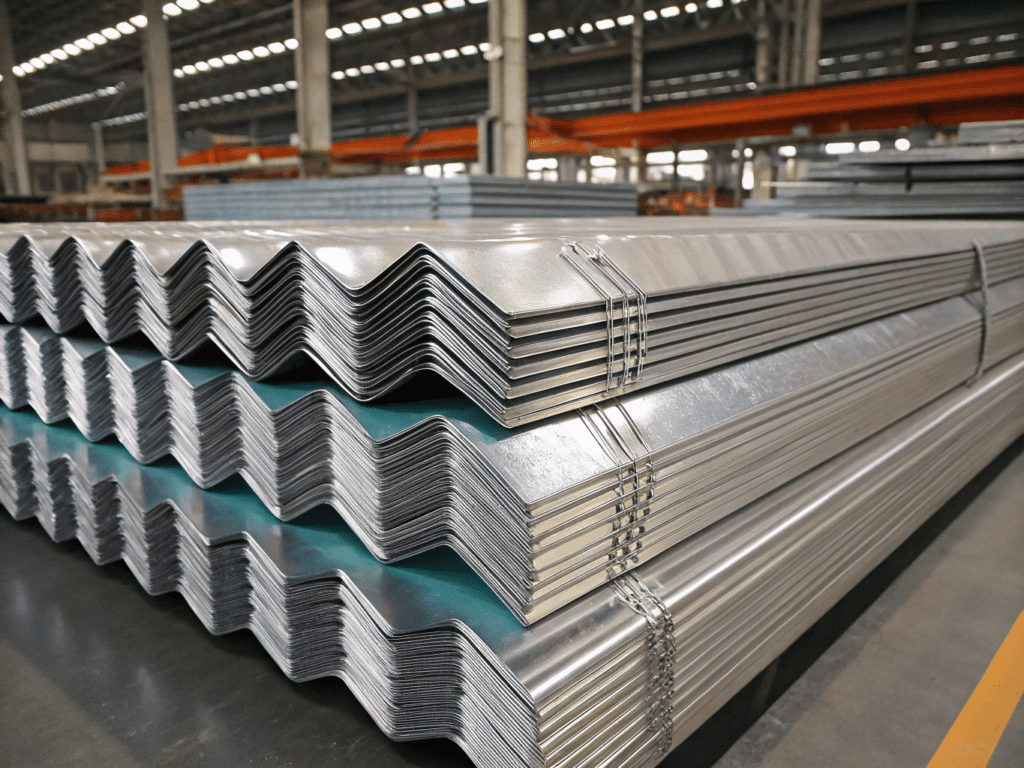
Quick answer: Stainless steel vs galvanized steel comes down to two mechanisms: galvanized steel is carbon steel coated with sacrificial zinc, stainless steel is an iron alloy with at least 10.5% chromium that forms a self-healing oxide layer. Choose galvanized for cost-driven outdoor structures and stainless where hygiene, salt or maintenance-free life matters; stainless typically costs 2–4× more per part. Request a quote for the same part in both materials.
Stainless Steel vs Galvanized Steel: Two Corrosion Strategies
Both resist corrosion by different mechanisms: stainless steel forms its own chromium oxide layer, while galvanized steel relies on a sacrificial zinc coating that corrodes in place of the steel beneath. Galvanized wins on price for outdoor structural parts; stainless wins where hygiene, salt or maintenance-free life justify the premium.
What Is Galvanized Steel?
Galvanized steel is carbon steel with a zinc coating that acts as a barrier and as a sacrificial anode: scratch it to bare steel and the surrounding zinc corrodes first, so the exposed steel stays rust-free — protection that survives minor damage, unlike a scratched paint film.
The coating is applied in two main ways:
- Hot-dip galvanizing immerses the steel in molten zinc at roughly 450 °C, producing a thick bonded layer that covers edges, corners and interiors — the standard choice for outdoor structural parts.
- Electro-galvanizing deposits a thinner, smoother layer that looks better under paint and holds tighter tolerances, but leaves sheared edges exposed.
Galvanized steel is coated carbon steel, so it shares the strength and low cost of our carbon steel sheet metal fabrication work; that guide's companion on galvanized and galvannealed sheet matters once the part will be painted or spot welded.
What Is Stainless Steel?
Stainless steel is an iron alloy with at least 10.5 percent chromium — roughly the level at which a stable passive layer forms. Chromium reacts with oxygen to create an invisible, self-healing oxide film that reforms when scratched, so corrosion resistance is a property of the metal, not a coating that wears away.
Two grades dominate specs. 304 is the general-purpose grade for food equipment, architectural trim and interior hardware. 316 adds molybdenum, which markedly improves resistance to chlorides, salt and process chemicals, making it the default for coastal and marine service. Ferritic 430 has no nickel: cheaper, less corrosion resistant, suited to mild indoor duty.
Stainless is harder and work-hardens faster than carbon steel, so it needs different tooling and more careful welding — see our stainless steel sheet metal fabrication page.
Does 304 Stainless Steel Rust? (and When It Does)
Yes, it can — and knowing when avoids field failures. Stainless does not rust like carbon steel, with an oxide layer flaking off; 304 pits and suffers crevice corrosion instead, under specific conditions.
- Chlorides. Stagnant salt water, salt spray, de-icing salts and chloride-laden dust; warm, stagnant conditions are worse than flowing water, so water traps fail before exposed faces.
- Crevices. Gaps under washers, between lapped panels or behind unsealed joints hold chlorides against the surface and starve it of oxygen.
- Carbon steel contamination. Grinding dust, tooling residue or a carbon steel brush leaves free iron that rusts — contamination, not an alloy problem.
- Heat tint and weld oxides. Welding burns away the passive layer around the bead, leaving a chromium-depleted zone far less resistant than the parent metal.
- Strong acids and chlorinated cleaning chemicals. These attack the passive layer directly if the grade is not matched to the duty.
The fixes are specific: specify 316 where chlorides are real, design out water traps and crevices, keep carbon steel tooling away, and restore the passive layer after welding. Our guide to stainless fabrication covers how those rules change cutting, forming and finishing.
304 vs 316: When 316 Is Worth the Premium
304 is the workhorse: about 18 percent chromium and 8 percent nickel, adequate for indoor, food and general industrial duty. 316 adds molybdenum, the single addition that resists chloride pitting and the reason coastal, marine and de-icing environments specify it.
Salt spray, road salt, chloride-bearing process water, coastal air or chlorinated wash-down means 316; fresh water, humidity, cleaning agents or food product means 304, which performs equally well for less. Paying for 316 in a dry indoor enclosure buys nothing, while 304 on a jetty guarantees premature failure. Both grades are weakly magnetic when annealed — a quick check against the strongly magnetic 430.
Key Differences
| Property | Galvanized Steel | Stainless Steel |
|---|---|---|
| Corrosion mechanism | Sacrificial zinc coating | Self-healing chromium oxide layer |
| Base metal | Carbon steel with zinc layer | Iron-chromium alloy (≥ 10.5% Cr) |
| Corrosion resistance | Good in atmospheric exposure | Good to excellent in most environments |
| Strength | High (carbon steel base) | High; similar or better per gauge |
| Weldability | Good; zinc fumes need ventilation and coating touch-up | Good; skilled welding avoids heat tint and distortion |
| Formability | Good, but sharp bends can crack the coating | Good; work-hardens quickly during forming |
| Appearance | Matte grey, spangled or smooth | Bright; brushed, polished or patterned |
| Relative cost | Lower | Higher — typically 2–4× |
| Practical temperature range | Zinc degrades above roughly 200 °C continuous | Depends on grade; generally wider |
| Typical service life | Years to decades by environment | Decades with the correct grade |
Corrosion and Rust Behaviour in Service
Galvanized steel rust appears when the zinc layer is consumed or bypassed:
- Cut and drilled edges expose bare steel unless galvanizing follows cutting.
- Deep scratches and heavy abrasion consume zinc faster than the surrounding coating protects it.
- Coastal air and road salt attack the zinc itself: white corrosion first, then red rust once the zinc is gone.
- Acidic rain, industrial fumes and acidic contact dissolve the coating.
Spec sheets quote years of atmospheric exposure, assuming an intact coating in a mild environment; where it is damaged, zinc-rich paint restores most protection — see our metal surface treatments guide. Avoiding water traps and galvanic contact between dissimilar metals matters as much, because corrosion is electrochemical.
Passivation and Why It Matters After Welding
Passivation removes free iron and surface contamination so the chromium oxide layer can re-form cleanly. It is not a coating; it restores the state the alloy needs to protect itself.
It matters most after welding, which heats stainless into a range where chromium combines with carbon at grain boundaries and oxidises at the surface, leaving the bead and heat-affected zone weaker than the parent metal — left as-welded in chloride service, that is where pitting starts. Depositing foreign iron does the same damage: a carbon steel grinding disc, wire brush or shared workbench.
Two rules follow. Clean mechanically with dedicated stainless tooling, so no foreign iron is embedded, then treat welded and heat-tinted areas so the passive layer is restored before service — which is why a hygienic or coastal welded assembly should state its post-weld treatment rather than leave it assumed. Our metal finishes chart places passivation and electropolishing alongside the other finishes that change how a stainless surface behaves.
Cutting and Welding Stainless: Contamination Rules
Stainless is only as corrosion resistant as the way it is handled. Four rules prevent most buyer problems:
- Keep stainless and carbon steel separate. Dedicated cutting, forming and brushing tools plus separate storage — a carbon steel wire brush leaves enough free iron to stain rust within days.
- Cut with a process that leaves no oxidised edge. Laser and waterjet both work, but edge condition and dross must be removed before finishing.
- Weld with the right process and low heat input. TIG suits thin stainless where appearance and corrosion resistance matter; stainless distorts more than carbon steel, so use a controlled sequence and effective fixturing.
- Restore the surface after welding. Remove heat tint and spatter, then passivate as the duty requires.
Welding galvanized steel is the mirror image: zinc vaporises into fume and causes porosity, so the coating is ground back and repaired afterwards with a zinc-rich product, and fume extraction is required because zinc oxide fume is a health hazard.
Galvanized vs Stainless: Cost per Unit of Life
Stainless steel typically costs 2–4 times galvanized carbon steel at the same gauge and geometry, sometimes more for 316 or specialty finishes; the multiple shifts with nickel and molybdenum prices. Galvanizing adds only a modest premium over plain carbon steel.
Material price is not the whole cost: stainless is harder to cut and form, wears tooling faster and demands more welding skill. Galvanized parts have hidden costs too, because cutting or welding after coating destroys zinc locally and edges then need touch-up.
The decisive number is cost per year of service. A galvanized frame may need recoating within its life, while a correctly graded stainless part typically will not and never needs a coating inspection — so the premium pays off on cabinets and process equipment that are expensive to access, but usually not on a simple outdoor structure that can be repainted.
Food, Medical and Outdoor Service: Which Steel
| Service environment | Usual specification | Why |
|---|---|---|
| Food, dairy, pharmaceutical contact | 304 stainless | Survives caustic cleaning and disinfectants; zinc coatings are not acceptable here |
| Medical, laboratory, cleanroom | 304 stainless | Cleanable, non-porous, no coating to shed |
| Coastal, marine, de-icing salt | 316 stainless | Molybdenum resists chloride pitting |
| Outdoor structure, painted | Galvanized carbon steel | Best durability per unit cost when the part can be inspected and maintained |
| Outdoor enclosure, coastal plant | 316 stainless frame, or galvanized frame with a full paint system | Decide by access for maintenance and by how corrosive the site really is |
| Indoor enclosure, painted | Cold-rolled or galvanized carbon steel | Cheap, stiff, stable indoors |
| Mild indoor trim | 430 stainless | Lower cost where corrosion duty is light |
Galvanized steel is not food safe, because zinc can migrate into acidic food: use it for structural service and stainless wherever the surface touches product.
Stainless Steel 304: How to Specify It on a Drawing
A drawing that names only "304" leaves the supplier guessing about the standard, finish and form: the same material is AISI 304 in US practice, EN 1.4301 in European practice, ordered to sheet specifications such as ASTM A240, so state the designation system alongside the grade.
| Attribute | What to state on the drawing |
|---|---|
| Grade and designation system | "AISI 304", "EN 1.4301" or the equivalent called out by your project standard |
| Family and composition | Austenitic, approximately 18% chromium and 8% nickel; confirm against the material certificate |
| Product standard and form | The sheet standard called out on the drawing, for example ASTM A240 |
| Thickness | Millimetres or gauge, with the base-metal thickness explicit |
| Surface finish | For example 2B, brushed or polished; state the finish the drawing requires |
| Density and mechanical properties | Take these from the material standard and the mill certificate for the actual heat — material certificates are available on request |
| Post-weld treatment | Heat tint removal and passivation where the duty requires it |
For stocked grades and finishes, our materials guide is a practical starting point, and the sheet metal grades guide places stainless alongside carbon, coated and aluminium sheet.
Pros and Cons
Galvanized Steel
| Pros | Cons |
|---|---|
| Low-cost corrosion protection for outdoor parts | Zinc layer eventually wears away |
| Self-healing at scratches via sacrificial action | Cut edges stay uncoated unless re-dipped after cutting |
| Strong, weldable carbon steel base | Poor in strong acids, alkalis and chloride splash |
| Fast, well-understood coating process | Not food-contact safe; dulls and shows white rust |
Stainless Steel
| Pros | Cons |
|---|---|
| No coating to wear out or chip | Costs more — typically several times galvanized |
| Self-healing passive layer on scratches and cuts | Needs skilled welding and dedicated tooling |
| Food, medical and chemical safe surfaces | Wrong grade can pit in severe chloride service |
| Long life in harsh and hygienic environments | Higher material and machining cost on every part |
Frequently Asked Questions
Q1: Does 304 stainless steel rust?
It pits or suffers crevice corrosion rather than rusting like carbon steel; triggers are chlorides, stagnant water, crevices, embedded carbon steel contamination and untreated weld zones. Specify 316 for chlorides, design out crevices and passivate after welding.
Q2: Which is better, stainless steel or galvanized steel?
Neither wins outright: galvanized is better value in ordinary atmospheric service where cost matters and the part can be inspected, while stainless is better where hygiene, chemicals, salt or long maintenance-free life matter.
Q3: Does galvanized steel rust?
Yes, once the zinc is consumed or bypassed — typically at cut edges, deep scratches, or under coastal salt and acid exposure. While zinc remains it protects the steel; afterwards, the steel rusts like any carbon steel.
Q4: Can galvanized steel be welded?
Yes, with precautions: welding vaporises zinc, so local exhaust ventilation and often a respirator are required. Parts are best welded before hot-dip galvanizing, or touched up afterwards with zinc-rich paint.
Q5: Can galvanized steel be painted or powder coated?
Yes, after proper preparation: the zinc must be degreased and etched or pretreated, or the film peels within months. Powder coating works the same way and suits enclosures needing protection plus a colour finish.
Q6: Is galvanized steel food safe?
Generally not for direct food contact, because zinc can migrate into acidic foods — which is why food, dairy and pharmaceutical equipment specifies stainless steel.
Q7: How much more expensive is stainless steel than galvanized steel?
As a planning figure, 2–4 times as much for the same part, varying with grade, nickel and molybdenum prices and fabrication complexity. Compare cost per year of service, not the material line item.
Related Reading
- Galvanized vs galvannealed steel — which zinc coating to specify for welding and painting.
- Metal finishes chart — passivation, electropolishing, plating and coatings compared.
- Zinc plating types — electroplated and hot-dip coatings on small and threaded parts.
- Outdoor equipment enclosures — how these material choices work out in a real product.
Conclusion
Stainless and galvanized steel both fight corrosion, but one is a sacrificial coating that wears out while the other is a self-healing property of the alloy. Galvanized is the economical choice for outdoor and structural service; stainless the right call for food, medical, coastal and long-life applications.
SafeFaber is a contract sheet metal manufacturer that fabricates both materials in house — cutting, bending, welding, finishing and assembly. Send your drawing and target environment and we will quote the same part in both materials.