Contract Metal Fabrication: Benefits, Process & How to Partner With a CM
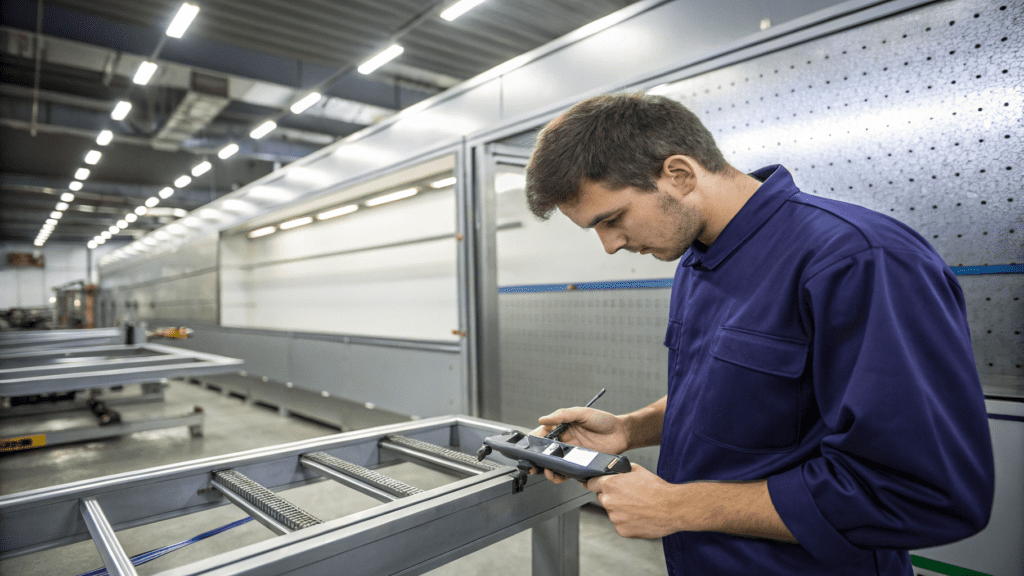
Contract metal fabrication is a model in which a certified factory produces metal parts and assemblies to your drawings, converting fixed capital into variable cost. The OEM vs ODM choice sits inside that model and decides who owns the design. Because most sheet metal work uses no hard tooling, revisions stay cheap, prototypes can start within days, and an agreement can run from a single order to a multi-year program.
This guide sets out the difference between OEM, ODM and contract manufacturing as buying models, how a contract manufacturer differs from a trading company, what to verify when sourcing sheet metal from China, and how to structure the RFQ, the ramp-up and the cost model so the relationship holds up after the first order.
OEM vs ODM vs Contract Manufacturer: Who Owns What
The OEM versus ODM question is really a question about two things: who owns the design, and who owns the brand the product sells under. A contract manufacturer is a third position — it builds to a design it does not own and sells under nobody's brand but yours.
| Model | Who owns the design | Whose brand | Typical buyer situation |
|---|---|---|---|
| OEM | The buyer. The factory manufactures to the buyer's drawings and specification | The buyer's | Product is defined, drawings exist, the buyer wants capacity rather than invention |
| ODM | The manufacturer, which offers a design the buyer can rebrand | The buyer's, over the manufacturer's design | Buyer wants speed to market and accepts a platform it did not design |
| Contract manufacturer (CM) | The buyer, with the CM contributing DFM and process engineering | The buyer's | Buyer wants an engineering partner that also owns the whole production route |
| Trading company | Neither party in the transaction — it passes the file on | The buyer's | Buyer wants a single commercial contact and accepts less visibility |
Most sheet metal programs are OEM or CM relationships: the customer owns the drawing, and the factory's value is in process engineering, tooling, quality documentation and delivery. The distinction narrows to how much engineering the factory contributes — a build-to-print arrangement with little DFM input sits at the OEM end, while a CM reviews the design and holds the process route.
OEM vs ODM: Which Model Fits Your Product Maturity
Product maturity decides the answer more than cost does. In early development, the design is still moving, so build-to-print with a CM that reviews drawings is the fastest route: no tooling commitment, revisions are cheap, and the engineering feedback lands while it can still change the design. In mature production, volume and repeatability dominate, and the priorities shift to capacity, cost reduction and documented quality.
An ODM route makes sense only when the buyer genuinely values speed over design ownership — for example when entering a product category it does not intend to differentiate in. Where the enclosure is the product, or where it carries a certification or a customer-specific interface, ODM hands away too much of the value.
Contract Manufacturing vs Buying From a Trading Company
A trading company sells capacity it does not own. That is not automatically worse — a good trader can consolidate several processes and take commercial risk off your desk — but it changes who controls quality, lead time and engineering.
| Question | Contract manufacturer | Trading company |
|---|---|---|
| Who runs the machines? | The supplier you are dealing with | Usually a third party you may never audit |
| Who answers a technical query? | Process engineers in the plant | A sales contact relaying messages |
| Process control | Material certificates, in-process checks, first-article inspection under one quality system | Depends on the sub-supplier and is harder to verify |
| Cost transparency | Can be broken into material, process, finishing and freight | Usually a single landed number with margin embedded |
| Design change response | Fast — the same plant re-quotes and re-runs | Depends on how many parties are in the chain |
The test is simple: ask which operations are performed in-house and which are subcontracted, then ask to see the facility. A contract manufacturer that runs cutting, forming, welding, finishing and assembly itself can answer for all of them; a trader has to go and ask. Our guide to how to choose a sheet metal fabrication partner sets out the full evaluation checklist.
Sourcing Sheet Metal From China: What to Verify
Sourcing outside your own region adds two risks that price alone does not capture: verification of capability, and control of the specification once production starts.
- Capability, not claims. Ask for the process list with material and thickness ranges, and match it against your part. A supplier that offers laser cutting, punching, bending, welding, machining, finishing and assembly in one facility removes the coordination risk that comes with a chain of subcontractors — the reason buyers look for a single metal parts manufacturer rather than three specialists.
- Quality system. An ISO 9001:2015 certificate is the baseline evidence that documented processes, inspection and traceability exist — SafeFaber's own system is certified to that standard. Ask for the scope and a sample inspection report. The wider sourcing and logistics side is covered on our supply chain page.
- How quotes are produced. A supplier that quotes from a drawing and returns a DFM review is reading your file. A supplier that returns a single number with no questions may be guessing at the unknown parts of the specification — and pricing the risk into the number.
- Documentation in production. Agree up front what travels with each shipment: material certificates, inspection results, first-article reports, and any finishing records such as plating thickness or bake cycles.
- Communication and time zone. Named engineering contacts, a response commitment and a written escalation path matter more over a long distance than they do locally.
IP, Tooling Ownership and Exclusivity Clauses
Three clauses decide what happens when the relationship ends, and they are cheaper to settle before the first order than after.
Intellectual property. The drawing, the CAD model and the product design belong to the buyer. State it, and put an NDA in place before files are exchanged rather than after a quotation is requested. Also agree how files are stored, who can access them, and what happens to them at the end of the program.
Tooling ownership. Where the program requires dedicated tooling — a die, a form tool, a fixture or a welding jig — say who owns it, who pays for maintenance, where it is stored and on what terms it can be transferred. The usual and fairest position is that tooling paid for by the customer belongs to the customer, with a documented handover route.
Exclusivity. Buyers often want assurance that their design is not sold to a competitor. A workable clause is specific: named products, named markets and a defined period, rather than a blanket restriction that a factory cannot police. Pair it with a volume commitment so both sides carry something.
Ramp-Up Gates: What Is Checked at Each Stage
| Gate | What is checked | What it protects |
|---|---|---|
| DFM review | How the design meets the process, which features cost more than they need to, and the tolerance strategy | Design decisions that would be expensive to reverse later |
| Prototype | Form, fit and function in production material and thickness | Design errors, caught while changes are still cheap |
| First-article inspection | Measured and documented results against the drawing, from the production setup | An unrecorded baseline that nothing later can be compared with |
| Pilot lot | Whether the setup repeats, under in-process checks, rather than having worked once | A process that was never capable of running repeatedly |
| Production | Batch results under the quality system and the change-control rule | Silent process drift after approval |
What Documentation Should Travel With Each Shipment
The documentation scope is a commercial decision, not a default, so agree it at quotation and write it into the purchase order. What the buyer intends to inspect against should appear on the quote, because a supplier cannot price a test it was never told about.
| Document | What it proves | When to ask for it |
|---|---|---|
| Material certificate | The grade and heat that were actually used | Whenever the drawing or the end customer names a specification |
| First article inspection report | That the first part from the production setup met the drawing | At the start of production, and again after any process change |
| In-process inspection record | That checks happened during the run, not only at the end | On repeat orders and on any part with a critical fit |
| Finishing record | Coating or plating specification and the parameters it was run to | On coated, plated or anodized parts inspected against a finish callout |
| Packing list and inspection release | What shipped, under which revision, and that it passed before dispatch | On every shipment where the buyer does goods-in on arrival |
The RFQ Package: What a CM Needs to Quote
A complete RFQ produces a comparable quotation and a short lead time; a partial one produces a wide price spread, and that spread is risk premium rather than competition. Send a drawing or a 3D model plus the notes the shop cannot infer:
- Material and grade, thickness, and any finish specification.
- Quantities: prototype, first production lot, and expected annual volume.
- Tolerances — general tolerance plus any critical dimensions that must be held.
- Finishing and hardware: coating type and colour, pressed-in fasteners, silk-screen printing, assembly scope.
- Packaging, labelling and the trade term you want quoted (EXW, FOB, CIF or delivered).
- Any standard or industry requirement the part must satisfy, and the documentation you expect with the shipment.
At SafeFaber every quotation includes a free DFM review, so manufacturability issues and cost-saving options are raised at quotation rather than at delivery; quotes come back within 24 hours, prototypes typically ship in 3–7 business days and production in 2–4 weeks. Our sheet metal quote guide covers the RFQ pack in more detail.
Ramp-Up: Prototype to Pilot to Production
Ramp-up is a sequence, and skipping a step is how a good prototype becomes a bad production part.
- DFM review. Engineers check the design against the processes, flag features that will cost more than they need to, and confirm the tolerance strategy before anything is cut.
- Prototype. A small quantity proves the design and the process route. Design changes are still cheap at this point, which is exactly why they should happen here.
- First-article inspection. The first part from the production setup is measured and documented against the drawing. That report becomes the baseline for everything that follows.
- Pilot lot. A small production run under the real process, with in-process checks, confirms that the setup repeats rather than merely worked once.
- Production. Batch production runs under the quality system, with documented results per batch and a change-control rule: no process change without agreement.
Two habits keep a ramp-up honest: keep the previous supplier running until the new route has proven itself, and agree in writing what constitutes acceptance at each gate, so every stage is a check rather than a discussion.
Cost Model: Unit Price vs Total Landed Cost
Unit price is the easy number to compare and the least reliable one to decide on. The number that matters is the landed cost of a conforming part, delivered when you need it.
| Cost element | Where it hides | How to control it |
|---|---|---|
| Material and process | Unit price | Design around standard sheet sizes and fewer operations |
| Tooling and NRE | Separate line, or amortised into unit price | Ask which it is, and how it behaves at higher volume |
| Finishing and hardware | Sometimes excluded from the unit price | Confirm scope on the quotation, not from memory |
| Packaging and freight | The trade term | Quote every supplier on the same Incoterm |
| Duty, clearance and insurance | Invisible until the invoice arrives | Define who pays under the agreed term |
| Quality failures and rework | Nowhere on the quote | Weigh documented inspection and traceability as part of price |
The structural point is that a low unit price on a loosely specified part is not a low price — it is a price with the risk removed and handed back to you. Fix the specification, fix the trade term, then compare. The full build-up of a fabricated part price is on our sheet metal cost breakdown page.
Frequently Asked Questions
What is the difference between OEM and ODM?
In an OEM arrangement the buyer owns the design and the factory manufactures to it. In an ODM arrangement the manufacturer owns the design and the buyer rebrands it. OEM suits buyers with a defined product; ODM suits buyers who want speed to market and accept a platform they did not develop.
What is the difference between a contract manufacturer and a regular supplier?
A contract manufacturer owns the full production process, provides engineering support and works under a documented quality system. A regular supplier may resell, or handle only part of the process.
Who owns the tooling and the design?
The customer, under a properly written agreement. Tooling, files and intellectual property belong to the buyer, with clear terms for storage, maintenance and return. Put the NDA in place before files are exchanged.
How do we start production with a new contract manufacturer?
Run the sequence: DFM review, prototype, first-article inspection, pilot lot, then production. Keep the previous supplier running until quality is proven, and agree written acceptance criteria at each gate so the decision is a check rather than a debate.
Do you sign NDAs?
Yes. NDAs and IP protection terms are standard for OEM programs, and files are handled on that basis from the first enquiry.
Related Reading
- How to choose a sheet metal fabrication partner — the qualification checklist.
- Finding a reliable fabrication partner — warning signs and how to test a supplier.
- Design and engineering support — where DFM review and drawing changes happen.
SafeFaber is a China-based contract sheet metal manufacturer running laser cutting from 0.5 mm to 20 mm, CNC punching, CNC bending, welding, machining, powder coating and assembly in one facility for OEMs, integrators and EPCs across the energy storage, data centre, HVAC, automotive, aerospace and architectural sectors — with industries served set out in full. We work on a quotation basis rather than self-service instant pricing, so every job is reviewed by an engineer before it is priced. Send your drawing or 3D model to start a qualification discussion.