EMI/RFI Shielding Enclosures: What to Specify

EMI/RFI Shielding Enclosures: What to Specify
Quick answer: An EMI/RFI shielding enclosure works by keeping a continuous conductive path around the electronics, so the shell, the seams, the apertures and the lid joint all have to carry current without a gap that radiates. Specify gasket grooves, bonding points, paint-free contact zones and the lid overlap on the drawing; thickness alone shields very little. Send us your drawing and we will confirm what we can supply.
1. Shielding Is Conductive Continuity, Not Thickness
Metal does not block interference the way a wall blocks light. The shell reflects most of the field and conducts the induced current away, and it does that only while the current has an uninterrupted path.
That makes shielding a continuity problem, not a thickness problem. Every seam, lid joint, aperture, cable entry and gland plate is a break in that path, so a heavy-gauge box with one long, loosely fastened seam can leak more than a thin box whose joints are bonded. Interference current travels on the metal surface and has to return without meeting an impedance bump; anything that raises impedance at a joint — coating, an insulating gasket, a gap, fasteners spaced too far apart — turns that joint into an antenna.
2. Apertures and Seams: Size Relative to Wavelength
Shielding effectiveness falls as frequency rises, because wavelength falls. A slot or seam starts behaving like an antenna once its longest dimension becomes a meaningful fraction of the wavelength, so general guidance is to keep the longest opening small against the wavelength at the highest frequency you must attenuate. At low frequencies that is forgiving; at higher frequencies the same seam becomes the dominant leak.
Numbers in this guide are general engineering references; your drawing and the standard it calls out govern the part we manufacture.
- Fastener spacing along a seam sets the length of each unbonded span, so closer spacing is usually the cheapest shielding improvement available.
- Many small holes beat one long slot of the same open area; deep, small-cell vent panels attenuate above a cutoff frequency instead of passing everything through.
- Cable entries are the biggest practical leak. Terminate the cable shield to the enclosure all round at the gland, not through a long pigtail wire.
- Windows and displays need a conductive mesh or transparent conductive layer over the opening.
Decide ventilation early: designing a screened vent into the enclosure costs far less than retrofitting one after an EMC test fails.
3. Gasket Grooves and Mating Surfaces
Conductive gaskets mount two ways. A groove-mounted gasket sits in a channel formed into the flange and is compressed when the lid closes. A surface-mounted gasket is bonded to a flat flange with adhesive. Grooves are preferred where the gasket must survive handling, where compression has to be controlled, and where the gasket should not take shear as the lid slides into place. In exchange, the fabricator needs the groove width, depth and corner radii, the gasket part number, and the compression target.
- Keep the path a closed loop with generous corner radii; sharp internal corners cut or kink the gasket.
- Put compression stops in the joint so a technician with a screwdriver cannot over-compress the gasket.
- Keep weld spatter, weld beads, screw heads and sealant out of the gasket path — each opens a gap.
- State whether corners are moulded or vulcanised, and whether gasket fitting is ours or yours.
Housing materials set the starting point. Galvanised steel gives a conductive zinc surface at low cost; aluminium is light and conductive but oxidises, so contact areas need a specified conductive treatment; stainless steel is conductive and corrosion-resistant at higher cost. Gasket options — conductive fabric over foam, conductive elastomer, knitted wire mesh, metal finger stock — trade compression set and environment against cost, so work from the supplier's compression data.
4. Grounding and Bonding Points
A shield only works if the enclosure is bonded to the ground reference the electronics use, and the bond must survive every removable joint.
- Where: a designated stud, clinched fastener or masked tapped hole on the frame, plus one on each removable panel and door.
- How: a paint-free landing on both mating surfaces, hardware that bites through coating, or a braided strap.
- What to list: mask zones before finishing, and put the bonding hardware on the bill of materials as specified items.
Two mistakes are common. Hinges and latches get treated as bonds, but a hinge is a mechanical joint, not a reliable low-impedance path across the door line, so add a strap or a dedicated bonding point. And masking gets assumed rather than specified — a powder-coated part will not have a bare contact ring unless the drawing asks for one.
5. Coatings: Conductive or Insulating
An insulating coating anywhere on a current path breaks the shield. That does not mean coated enclosures cannot shield; it means the drawing has to state masking zones and bonding hardware so the current path stays conductive.
Ingress protection is a separate subject and is often confused with shielding. An IP rating describes how well a housing keeps out solid objects and water, and it is established by testing the finished design to the relevant standard; it says nothing about shielding effectiveness. A plastic box can hold a good ingress rating and shield nothing, while a well-bonded metal enclosure with an open screened vent can shield well and hold no ingress rating. If you need both, they are two requirements on one drawing, and the gaskets are usually two different parts in separate grooves.
6. What to Put on the Drawing
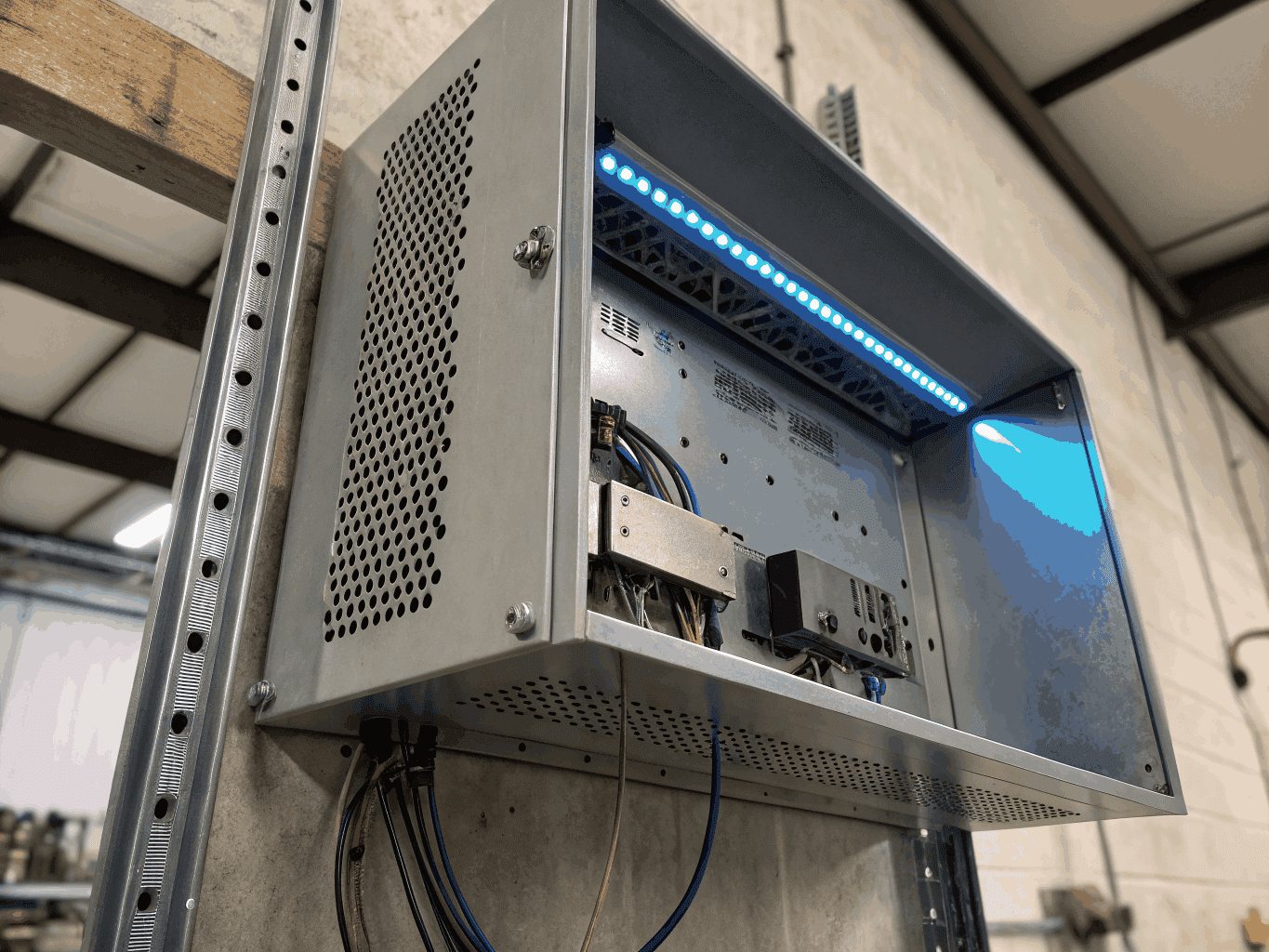
SafeFaber builds sheet metal industrial cabinets and enclosures and control panel enclosures with 0.5–20 mm laser cutting, CNC bending up to 3 m, CNC punching, MIG/TIG/spot welding, in-house powder coating and turnkey assembly. Masking, bonding hardware and gasket fitting change the process route, so those items are quoted and confirmed per project. Our engineers review every file free of charge through design engineering; finishing options are covered under metal surface treatments.
Frequently Asked Questions
Q1: What is the difference between EMI and RFI shielding?
EMI is the broad term for electromagnetic interference; RFI is interference in the radio-frequency part of the spectrum. For an enclosure the fix is the same: a continuous conductive path around the electronics, closed at every seam and aperture.
Q2: Does a thicker metal enclosure shield better?
Only at low frequencies, where thickness and permeability do the work. Above that, shielding depends on joint continuity, so a thin enclosure with bonded seams and short fastener spacing can outperform a heavy-gauge enclosure with long unbonded seams.
Q3: Do I need a conductive gasket if my enclosure has a weather seal?
Yes, if shielding is a requirement. Weather seals are normally insulating, so they close the gap against water without restoring the current path. Most designs that need both use two gaskets in separate grooves.
Q4: How does powder coating affect shielding?
Powder coating is an insulator, so it breaks the current path wherever it lands on a mating surface. Keep coating on exterior faces, mask the contact rings, lid lands, seam flanges and bond points, and use bonding hardware that bites through coating.
Still deciding? Send us your drawing — free DFM review and a quote within 24 hours.