Laser Cutting Sheet Metal: Process, Tolerances, Materials & Applications
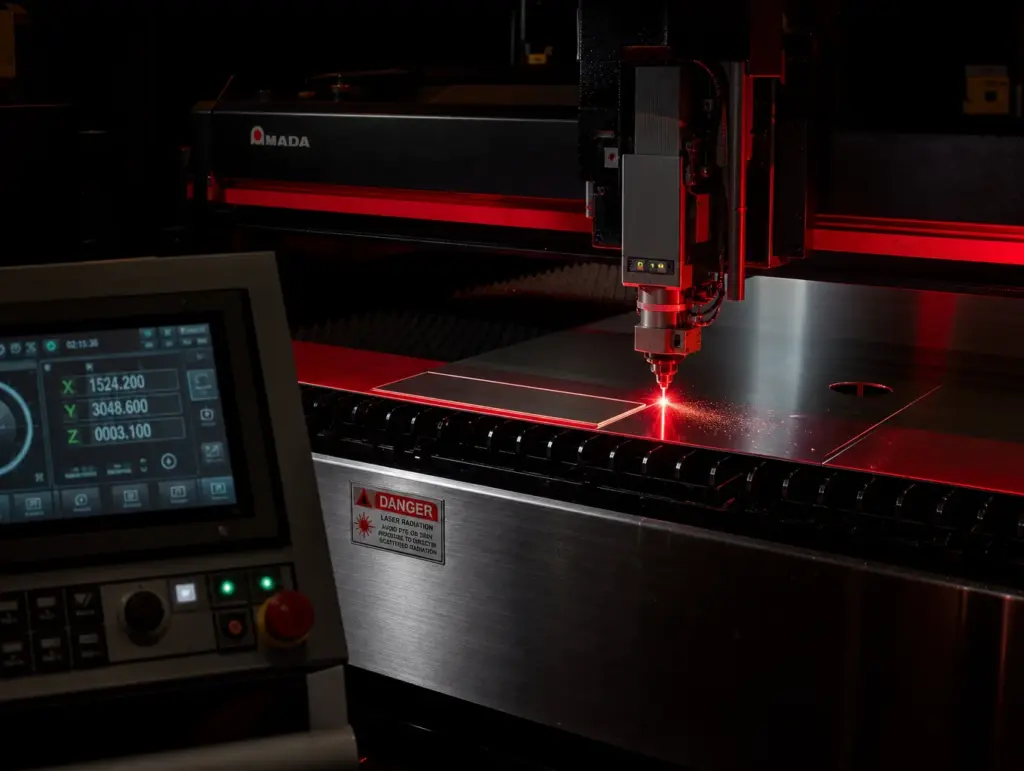
Quick answer: laser cutting sheet metal needs no tooling — a fiber laser beam cuts flat metal profiles straight from CAD files, so the process suits complex contours and low- to mid-volume production. Expect about ±0.1 mm on thin sheet, widening to roughly ±0.2 mm on 10–20 mm plate, and it covers 0.5–20 mm across carbon steel, stainless and aluminum. Kerf — the width of the cut itself — is typically a few tenths of a millimeter, and the machine compensates for it. Send your drawing for a quote.
Laser Cutting Sheet Metal: How It Works
Laser cutting of metal sheets is the default way to produce flat parts. A focused beam melts the material in milliseconds and a jet of assist gas blows the molten metal out of the cut, leaving a slot — the kerf. There are no dies to build and no tooling to amortize, so the first part costs as little to program as the thousandth. Most sheet metal work runs on fiber lasers, whose short wavelength is absorbed well by reflective metals such as aluminum and copper. Three parameters define a job: focus and spot size, which control kerf width and the smallest cleanly cut feature; power and speed, tuned to grade and thickness; and assist gas — nitrogen for oxide-free edges on stainless and aluminum, oxygen for carbon steel where the exothermic reaction adds cutting energy, and shop air for economical thin-gauge work.
What Is Kerf and How It Changes Your Part
Ask what is the kerf and you are asking about the material the beam destroys as it travels: the slot left behind is the kerf, and its width depends on spot size, focus position, material and thickness. The meaning of kerf in sheet metal is practical rather than academic — the cut path must be offset by half the kerf so the finished part matches the drawing, which is why you dimension the finished part and let the fabricator prepare the toolpath. Kerf also sets real limits: two holes closer together than the kerf plus a web of material cannot be cut reliably, and an internal corner can never be sharper than the beam.
Laser Cutting Tolerances and Minimum Feature Size
Positioning accuracy is confirmed against the machine specification and your drawing rather than published as a fixed figure, and real parts see broader variation because heat, thickness and geometry all play a role. As a rule of thumb, expect about ±0.1 mm on thin sheet, opening to roughly ±0.2 mm as thickness approaches 10–20 mm. What moves the tolerance: material thickness, because thicker plate tapers edges slightly; part size and geometry, since long thin parts distort; feature density, because clusters of small features heat the surrounding material; and edge condition, calibration and bed flatness. Tolerances between features on the same part are usually tighter than between separate parts, since the whole part is cut in one pass — so dimension the finished part and do not add your own kerf allowances.
Minimum feature size follows the material. As a working rule, a round hole of about one material thickness cuts reliably in common gauges (a 2 mm hole in 2 mm steel); smaller holes are possible in thin sheet but edge quality drops and cost rises. Keep slot and web widths around one thickness or more, because very thin webs distort under heat. Internal corners come off the machine with a small radius, so specify a generous radius rather than a sharp inside corner, while outside corners can be sharp. Keep holes about one thickness from an edge and features at least 2.5×t plus the bend radius from a bend line, and where parts are cut and then bent, dimension the flat pattern from a common datum so cutting and bending tolerances do not stack.
Dross, Burr and Edge Quality After Cutting
Edge quality is where laser cutting is judged, and the vocabulary is worth knowing. Dross is the resolidified metal that clings to the underside of a cut, most common on thicker plate and on aluminum; it usually means the parameters, focus or gas pressure need adjusting. A burr is a raised lip of material at the edge, and it matters commercially as well as cosmetically: a burr on the tension side of a bend starts a crack, and a burr anywhere a hand will touch is a safety and coating problem. Nitrogen-cut stainless comes off the machine bright and oxide-free, while carbon steel cut with oxygen carries a thin oxide film that is normally removed or coated over.
Cutting Aluminum, Stainless and Galvanized: What Changes
The beam is the same; the material changes the recipe and the limits. Carbon steel is the workhorse: laser cutting steel sheet from about 0.5 mm to roughly 20 mm is routine, and most products use 0.5–3 mm gauge anyway. Stainless 304 and 316 cut cleanly with nitrogen, which makes stainless steel laser cutting the standard route for food, medical and coastal equipment. Aluminum reflectivity used to be a problem and modern fiber sources handle it well, so aluminum sheet laser cutting is routine across the 0.5–20 mm range, though thicker plate needs more power and careful dross control. Galvanized steel cuts cleanly but the zinc vapor needs extraction and the cut edge loses some coating, so the exposed edge is a corrosion consideration.
Fiber Laser vs CO2 for 0.5 mm to 20 mm Sheet
For the thickness range this business actually cuts, fiber wins on nearly every axis: it absorbs well in reflective metals, cuts faster on thin and medium gauge, needs no laser gas and less maintenance, and holds edge quality across the 0.5–20 mm span. CO2 machines still appear in some shops, mainly for very thick stainless plate, and are otherwise being replaced. The practical consequence for a buyer is that laser cut now means fiber laser, and the questions that decide your part are power, assist gas and nesting rather than the source type. Precision laser cutting at the tight end comes down to machine condition and sheet flatness.
Laser Cutting vs Plasma vs Waterjet
Choosing a cutting process is a trade between accuracy, cost and speed, and the three alternatives carve out different territory.
| Criteria | Laser cutting | Plasma cutting | Waterjet cutting |
|---|---|---|---|
| Typical tolerance | ±0.1–0.2 mm | ±0.5–1 mm | ±0.1–0.25 mm |
| Edge quality | Clean, small heat-affected zone | Rough edge, heat-affected zone, dross | No heat-affected zone, slight taper |
| Practical thickness | About 20–30 mm steel | 50 mm and more | 100 mm and more |
| Setup and consumables | Files only, no tooling | Consumables, electrode and nozzle wear | No tooling; abrasive cost |
| Speed | Fast on thin to medium plate | Fastest on thick plate | Slow |
| Best at | Complex profiles, fine features, low to mid volume | Heavy structural steel where speed beats edge quality | Thick plate and heat-sensitive alloys |
So the choice follows the part. A cutting plasma cutter is the economical tool for heavy structural work where a rough edge will be welded or hidden, and a CNC plasma table is the classic answer for plate above laser's comfortable range. Waterjet cutting services take over where a heat-affected zone is unacceptable — heat-treated alloys, thick non-ferrous plate, parts that must not see thermal distortion — at the cost of speed and abrasive. Plasma and waterjet are separate processes rather than in-house capabilities here; where a job needs them, say so early so the route can be confirmed before quoting.
Laser Cutting vs Punching: Which Process for Your Part
CNC punching is the other tool-free process in most shops, and it is not a slower version of the same thing. Punching is very fast on repetitive hole patterns, holds tolerances through the tooling rather than the beam, and can form features as it goes — louvers, embosses, countersinks and tabs — that a laser cannot make in a single pass. It does need punch tooling, so it pays off at volume and on parts whose hole pattern repeats. Choose laser for complex contours, fine features and runs whose shapes change often, and punching for very high volumes of repetitive holes. Many shops run both, and we do: laser sheet metal cutting and CNC punching on the same floor.
One practical note about how quotes are made. Instant online laser cutting pricing exists for simple flat parts uploaded to a self-service portal, and it works when a part is one thickness, one material and no assembly. Contract manufacturing sits one level up: a drawing or STEP file goes to an engineer, the DFM review happens before pricing, and the quote covers material, cutting, forming, welding, hardware, finishing and inspection as one route.
Nesting, Material Yield and How It Affects Price
Nesting is where the material cost is won or lost. Software packs parts onto standard sheet sizes such as 1250 × 2500 mm or 1500 × 3000 mm, and where geometry allows, adjacent parts share one cut line — common-line cutting — which saves both material and machine time. Two consequences follow for buyers. First, quantity and geometry interact with price: a part that nests efficiently gets cheaper per piece as volume rises, while a part with a wasteful shape stays expensive however many you order. Second, small design changes can improve yield: aligning part edges, avoiding awkward protrusions and grouping similar parts in one order all raise the number of pieces per sheet. Heat is the other nesting constraint, because dense lettering or many small holes concentrate heat in one area, so parts are balanced across the sheet to limit distortion. After cutting, the sheet skeleton is removed and the parts are knocked free from the small micro-joints that held them in place, and the joint burrs are cleaned before the blanks move on to bending, hardware, welding and finishing. Buying several parts in one order usually costs less than buying them separately, because one nest and one setup serve the whole batch.
Frequently Asked Questions
What thickness can a laser cutter handle? Production fiber lasers cut carbon steel, stainless and aluminum across 0.5–20 mm. Most sheet metal products fall in the 0.5–3 mm range, where laser cutting is routine.
What is the minimum hole size for laser cutting? Roughly the material thickness — about 2 mm in 2 mm steel. Smaller holes are possible in thin sheet, but edge quality drops, so design with the 1× rule first and confirm with your fabricator if you must go below it.
What tolerance does laser cutting hold? Typical tolerances are ±0.1 mm on thin sheet, widening to around ±0.2 mm on plate up to 10–20 mm. If you need a tighter tolerance on specific features, mark those dimensions on the drawing and the fabricator will confirm what is achievable for your material and thickness.
Laser cutting or punching — which should I choose? Laser for complex profiles, frequent design changes and low to mid volumes; punching for very high volumes of repetitive holes and for formed features such as louvers and embosses. Many shops run both and route each feature to the better process.
What files do you need for a quote? A 3D model (STEP or IGES) or 2D drawing (DXF or DWG) with material grade, thickness, quantity, and any critical tolerance or finishing notes. Dimension the finished part; the fabricator prepares the flat pattern.
Related reading: the CNC punching guide covers turret tooling, louvers and formed features, the countersink and hole sizing chart handles hole and seat callouts in detail, and the sheet metal bending guide picks up where cutting leaves off.
Ready to cut a blank? Send your drawing — free DFM review, a quote within 24 hours, prototypes typically in 3–7 business days and production in 2–4 weeks, door to door from Yantai, China under ISO 9001:2015.